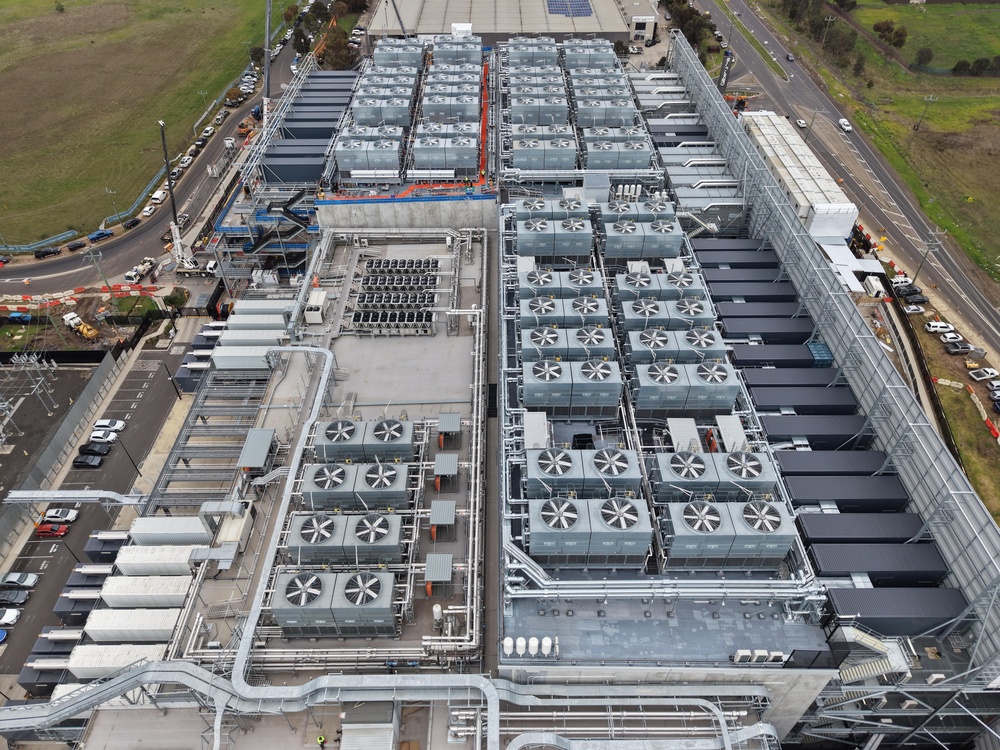



This week, the Victorian Government released the ‘Sustainable Data Centre Action Plan.’
The Plan outlines that in August 2026 National Cabinet agreed that large Data Centres require consistent, mandatory national standards in relation to energy, water and land use impacts.
Whilst recognising that Data Centres are essential infrastructure for the global digital economy and that Victoria is an optimal location for Data Centres, the Action Plan opines that there is a need for community guardrails relating to energy, water, planning and traffic management.
From a planning perspective, the prohibition of Data Centres within the residential suite of zones is not a controversial change.
However, the proposed 150-metre buffer between a Data Centre and a Residential Building (which we take to mean ‘dwelling’) appears as an arbitrary setback, as Data Centres can meet EPA noise protocols well within such a buffer. Presumably, there will be some further analysis of the buffer during industry consultation.
There are also a number of industrial precincts in Melbourne that have interfaces with residentially zoned land that include noisier and older industry that carry greater amenity impacts when compared to a Data Centre.
Presently ‘buffers’ for industrial and warehouse uses in the planning scheme at Clause 53.10 are non-mandatory setbacks and regulate referrals to the EPA.
We assume then that such a proposed buffer might need to be introduced by a Section 2 condition in a zone control, or via a newly introduced Particular Provision.
Data Centres will no longer be discretionary in rural zones (which includes the Green Wedge Zone), unless near compatible infrastructure, and further clarity will be needed in relation to the discretionary allowable distance from such infrastructure. We note that the Green Wedge Action Plan had previously advocated for an outright prohibition in the Green Wedge Zone.
The requirement for Data Centres to have their own renewable energy supply to match new electricity demand and the use of non-potable water options will bring challenges. Whilst understandably aimed at reducing energy demands on the grid, mandating renewable energy supply for data centres may not be feasible in an urban context where space is limited or co-location with a renewable energy source is not possible.
It is unclear whether a financial contribution to renewable energy would be an appropriate alternative.
The requirement to use recycled or other non-potable water sources for data centres may encourage the development of closed-loop re-circulating water cooling systems, rather than open-loop systems (continual water use).
While this approach can reduce reliance on drinking water supplies, the availability of infrastructure to provide suitable non-drinking water across Victoria may not be capable of supporting all potential data centre sites.
This could disincentivise Data Centre investment in Melbourne and is not required of other industry.
Overall, these are substantive proposed changes aimed at the Data Centre sector that reduce the locations where the use is discretionary, seek to introduce a mandatory buffer to dwellings, aim to regulate power and water use and require local investment.
The media release indicates that the new rules won’t be retrospective for applications under current assessment, inferring that they will likely be considered for new applications.